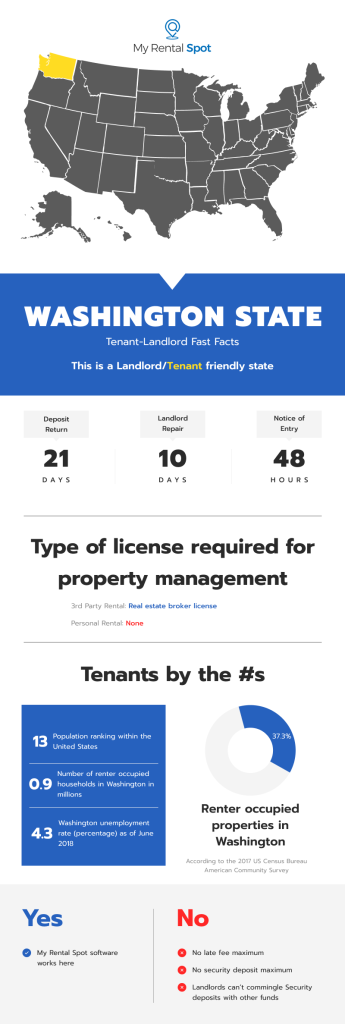
Landlords and tenants will face legal issues during the rental process, but not every issue needs to involve the courts. This article will help you learn how the laws in your state handle everything from security deposits to termination notices so you can easily navigate these.
This article is not an exhaustive or a substitute for qualified legal advice. Laws and statutes are subject to change and may vary by county or city. You are responsible for performing your research and complying with all laws applicable to your unique situation.
We recommend consulting with the appropriate government agencies and a qualified lawyer if you have legal questions or concerns. Your state bar association may have a referral service to help you find a lawyer with experience in landlord-tenant law.
Deadline for Returning Security Deposit: 21 days (RCW §§ 59.18.280)
Security Deposit Interest: Unless otherwise agreed in writing, the landlord shall receive interest paid on such trust account deposits. (RCW §§ 59.18.270)
Separate Security Deposit Bank Account: Required (RCW §§ 59.18.270)
Non-refundable Fees: Allowed, but they must not be part of the security deposit and must be designated as a “non-refundable fee” in a written lease agreement. (RCW §§ 59.18.285)
Require Written/Signed Move-In Checklist: No deposit may be collected by a landlord unless the rental agreement is in writing and a written checklist or statement specifically describing the condition and cleanliness of or existing damages to the premises and furnishings, including, but not limited to, walls, floors, countertops, carpets, drapes, furniture, and appliances, is provided by the landlord to the tenant at the commencement of the tenancy. The checklist or statement shall be signed and dated by the landlord and the tenant, and the tenant shall be provided with a copy of the signed checklist or statement. (RCW §§ 59.18.260)
Require Itemized List of Damages and Charges: Yes (RCW §§ 59.18.280)
Record Keeping of Deposit Withholdings: No Statute
Receipt of Deposit: Yes, the landlord shall provide the tenant with a written receipt for the deposit and provide written notice of the name, address, and location of the depository and any subsequent change thereof. (RCW §§ 59.18.270)
Failure to Comply: If the landlord collects a deposit without providing a written checklist at the commencement of the tenancy, the landlord is liable to the tenant for the deposit amount, and the prevailing party may recover court costs and reasonable attorneys’ fees. (RCW §§ 59.18.260)
Lease, Rent & Fees:
When Rent Is Due: No Statute
Rent Increase Notice: 30-day written notice for month-to-month leases. (RCW §§ 59.18.140)
Rent Receipt: A landlord shall provide a receipt for any payment made by a tenant in cash and, upon a tenant’s request, a written receipt for any payments made in a form other than cash. (RCW §§ 59.18.063)
Rent Grace Period: No Statute
Late Fees: No Statute
Prepaid Rent: No Statute
Returned Check Fees: Allowed but must not exceed forty dollars or the face amount of the check, whichever is less. (RCW §§ 62A.3-515)
Tenant Allowed to Withhold Rent for Failure to Provide Essential Services (Water, Heat, etc.): Yes, but the tenant must notify government authorities and deposit the withheld rent into an escrow account. (RCW §§ 59.18.115)
Tenant Allowed to Repair and Deduct Rent: Yes
If the repair requires a licensed professional, the tenant must provide the landlord with an estimate before the work is performed, and the repair cost must not exceed two months’ rent. (RCW §§ 59.18.100)
If the repair does not require a licensed professional, the tenant may repair the defective condition in a workmanlike manner, and the repair cost must not exceed one month’s rent. The total costs of repairs deducted in any twelve months under this subsection shall not exceed one month’s rent. (RCW §§ 59.18.100(3))
Landlord Must Make a Reasonable Attempt to Mitigate Damages to Lessee, including an Attempt to Rerent: Yes (RCW §§ 59.18.310)
Abandonment: Landlord can store and eventually sell the tenant’s personal property to compensate for damage. Landlord must follow specific instructions found in RCW §§ 59.18.310(b).
Notices and Entry:
Notice to Terminate Tenancy – Fixed End Date in Lease: No notice is needed as the lease expires. (RCW §§ 59.04.030)
Notice to Terminate Tenancy – Month-to-Month Lease (or other periodic term): 20 days or more from lease expiration. Less than 20 days’ notice is allowed for any tenant who is an armed forces member and receives deployment orders. (RCW §§ 59.18.200(1a-b))
Termination of Unapproved Tenancy (Squatters): An unapproved tenant is liable for rent for the time he/she occupied the dwelling and must turn over the premises immediately at the owner’s demand. (RCW §§ 59.04.050)
Notice of Date/Time of Move-Out Inspection: No Statute
Notice of Termination of All Other Leases for Nonpayment: 3 days (RCW §§ 59.12.030(3)
Utility Shut-offs Allowed: No. The landlord may be obligated to pay actual damages plus $100 per day of disrupted service plus court/attorney costs. (RCW §§ 59.18.300)
Disclosures and Miscellaneous Notes:
Official Duties of Landlord: Read RCW §§ 59.18.060 for a detailed summary.
Official Duties of Tenant: For a detailed summary, read RCW §§ 59.18.130.
Name and Addresses: The landlord must designate to the tenant the name and address of the person who is the landlord by a statement on the rental agreement or by a notice conspicuously posted on the premises. (RCW §§ 59.18.060)
Copy of the Lease: For written rental agreements, the landlord shall provide an executed copy to each tenant who signs the rental agreement. The tenant may request one free replacement copy during the tenancy. (RCW §§ 59.18.065)
Lead Disclosure: Landlords must disclose all known lead paint hazards. Landlords must also provide tenants, as an attachment to a written lease, with an information pamphlet on Lead-based paint hazards.
Adverse Action Notice: If an applicant is rejected during the screening process, the landlord must give notice using the RCW §§ 59.18.257 template.
Domestic Violence Situations:
Proof of Status: The Landlord is entitled to verify the claim of Domestic Violence status. Tenant must complete the RCW §§ 59.18.575(1b) form.
Termination of Lease: A tenant can terminate a lease with proof of Domestic Violence status, however the request to terminate must happen within 90 days from the incident date. (RCW §§ 59.18.575(1b))
Landlord Cannot Terminate Lease: A landlord may not terminate a tenancy, fail to renew a tenancy, or refuse to enter into a rental agreement based on the tenant’s or applicant’s or a household member’s status as a victim of domestic violence, sexual assault, or stalking. (RCW §§ 59.18.580)
Landlord Cannot Fail to Renew: A landlord may not terminate a tenancy, fail to renew a tenancy, or refuse to enter into a rental agreement based on the tenant’s or applicant’s or a household member’s status as a victim of domestic violence, sexual assault, or stalking, or based on the tenant or applicant having terminated a rental agreement under RCW 59.18.575. (RCW §§ 59.18.580)
Responsibility of Rent: Depending on the situation, the tenant may still be liable for the rent for the month in which he or she terminated the rental agreement. Read RCW §§ 59.18.575(2) and RCW §§ 59.18.575(3) for clarification.
Retaliation: Landlord must not terminate or refuse to renew a lease to a tenant who has filed an official complaint to a Government Authority or has exercised his or her legal rights and remedies in the last 90 days. (RCW §§ 59.18.240, 59.18.250)
Business License Required: No state-wide statute, but local cities and counties may have regulations and requirements. Check with your local governing authority.
Seattle Rental Registration: Rental properties in Seattle must be registered with the Department of Planning and Development. (source) (SMC §§ 22.214)
This guide is not legal advice. Laws change and may vary by county or city — verify
against the linked official statutes and consult a qualified lawyer for your situation.