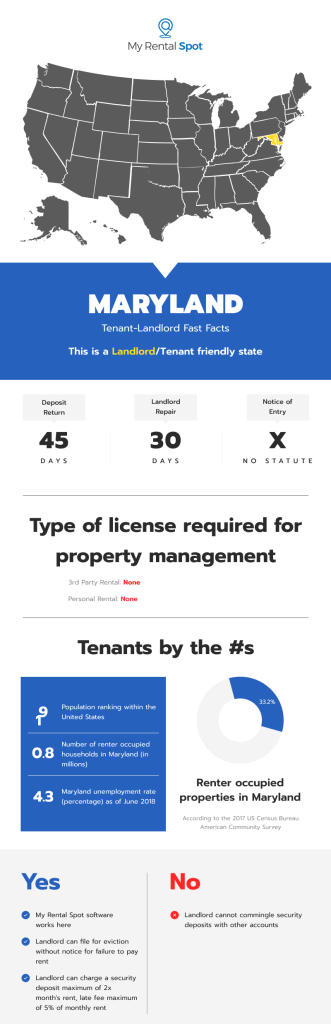
Max Security DepositNot to exceed the equivalent of two months’ rentFull text below ↓
Deposit Return45 days, or the landlord forfeits the right to withhold any portion of the deposit. The tenant can sue for three times the amount of the deposit, plus “reasonable attorney’s fees”Full text below ↓
Entry NoticeNo statute
Late FeesLandlords may charge a late fee that cannot exceed 5% of the rent due. If weekly rentals, a maximum late fee of $3 per week can be chargedFull text below ↓
Landlords and tenants will face legal issues during the rental process, but not every issue needs to involve the courts. This article will help you learn how the laws in your state handle everything from security deposits to termination notices so you can navigate these with ease.
This article is notintended to be exhaustive or a substitute for qualified legal advice. Laws and statutes are subject to change and may vary by county or city. You are responsible for performing your research and complying with all laws applicable to your unique situation.
If you have legal questions or concerns, we recommend consulting with the appropriate government agencies and a qualified lawyer in your area. Your state bar association may have a referral service to help you find a lawyer with experience in landlord-tenant law.
Security Deposit Interest: Yes, the security deposit can earn interest, which must be returned to the tenant when the deposit is returned. The deposit can either earn 1) the daily U.S. Treasury yield curve rate (“Constant Maturity Treasury”) for one year, as of the first business day of each year, or 2) 1.5%, whichever is greater (Md Real Property Code, 8-203(e)(1,2,3)). Use this handy interest calculator to determine how much interest is required.
Separate Security Deposit Bank Account: Yes, the deposit must be kept in a federally insured financial institution that operates in the state. (Md Real Property Code, 8-203(d)(1)(i)).
Pet Deposits and Additional Fees: No statute.
Non-Refundable Fees: No statute.
Deadline for Returning Security Deposit: 45 days, or the landlord forfeits the right to withhold any portion of the deposit. The tenant can sue for three times the amount of the deposit, plus “reasonable attorney’s fees” (Md Real Property Code, 8-203(e)(4), 8-203(g)(1,2)).
Permitted Uses for the Deposit: The deposit, in its entirety or a portion, may be withheld to pay for 1) unpaid rent; 2) damage due to lease violations or damage made by the tenant beyond ordinary wear and tear (Md Real Property Code 8-203(f)(1)(i)).
Receipt of Deposit: Landlords must provide a receipt of any security deposit given by the tenant. This receipt can be documented in the lease and does not need to be a separate document (Md Real Property Code, 8-203(c)).
Failure to Comply: If landlords fail to return the security deposit as state statute dictates, they can be sued by the tenant for up to three times the amount of the deposit withheld, plus “reasonable attorney’s fees” Md Real Property Code, 8-203(e)(4) and 8-203.1(7).
Written Lease Required: Yes, if the landlord rents five residential rental units, or more, in Maryland (Md Real Property Code, 8-208(1)).
Late Fees: Landlords may charge a late fee that cannot exceed 5% of the rent due. If weekly rentals, a maximum late fee of $3 per week can be charged (Md Real Property Code, 8-208(d)(3)).
Notice to Terminate Tenancy – Fixed End Date in Lease: No notice is required as the lease simply ends.
Notice to Terminate a Lease – Yearly Lease: Three months. In the case of farm tenancies, notice can be given in six months. In Montgomery County, two months’ notice is required, except for single-family homes. This does not apply to Baltimore City (Md Real Property Code, 8-402(b)(3)).
Notice of date/time of Move-Out Inspection: Required. Tenants have the right to be present at the inspection.
Eviction Notice for Nonpayment of Rent: Five days.
Eviction Notice for Lease Violation: 30 days. If there is a clear and imminent danger to tenants or other people, the notice can be given within 14 days (Md Real Property Code 402.1(a)(1)).
Required Notice before Entry: No statute.
Entry Allowed with Notice for Maintenance and Repairs (non-emergency): No Statute.
Emergency Entry Allowed without Notice: No statute.
Entry Allowed During Tenant’s Extended Absence: No statute.
Domestic Violence Situations: Tenant may terminate a lease early in special circumstances involving sexual assault, sexual abuse, or domestic violence (Md Real Property Code, 8-5A-02(a)(1,2)).
Landlords can require tenants to provide proof of domestic violence status from tenants. (Md Real Property Code, 8-5A-03 and 8-5A-04).
Landlord’s Duties:
Tenant’s Duties:
Retaliation: Landlord must not take possession of premises, terminate a tenancy, increase rent, or decrease services to a tenant who has filed an official complaint to a Government Authority, has involvement in a Tenant’s Organization, or file a lawsuit against the Landlord. Any such action will be considered a “retaliatory action” (Md Real Property Code, 208.1 (1-3)).
Lead Disclosure: Landlords must disclose all known lead paint hazards. Landlords must also provide tenants, as an attachment to a written lease, with an information pamphlet on lead-based paint hazards.
The right to have the dwelling unit inspected by the landlord in the tenant’s presence to make a written list of damages that exist at the commencement of the tenancy if the tenant so requests by certified mail within 15 days of the tenant’s occupancy;
The right to be present when the landlord inspects the premises at the end of the tenancy to determine if any damage was done to the premises if the tenant notifies the landlord by certified mail at least 15 days before the date of the tenant’s intended move, of the tenant’s intention to move, the date of moving, and the tenant’s new address;
The landlord’s obligation to inspect within 5 days before or after the tenant’s stated date of intended moving;
The landlord’s obligation to notify the tenant in writing of the date of the inspection;
The tenant’s right to receive, by first-class mail, delivered to the last known address of the tenant, a written list of the charges against the security deposit claimed by the landlord and the actual costs, within 45 days after the termination of the tenancy;
The obligation of the landlord to return any unused portion of the security deposit, by first-class mail, addressed to the tenant’s last known address within 45 days after the termination of the tenancy; and
A statement that failure of the landlord to comply with the security deposit law may result in the landlord being liable to the tenant for a penalty of up to 3 times the security deposit withheld, plus reasonable attorney’s fees.
Right to Due Process: Landlords may not take possession of the leased premises, or the tenant’s personal property, unless the lease has been terminated by action of the parties or by operation of law, and the personal property has been abandoned by the tenant without the benefit of formal legal process. (Md Real Property Code, 8-208(d)(6)).
Court Related:
Maryland Small Claims Court:
Limits: $5,000.
Eviction Cases Allowed: Yes, but the claim amount must not exceed $5,000.
Business License required: No state-wide statute, but local cities and counties may have regulations and requirements. Check with your local governing authority.
This guide is not legal advice. Laws change and may vary by county or city — verify
against the linked official statutes and consult a qualified lawyer for your situation.