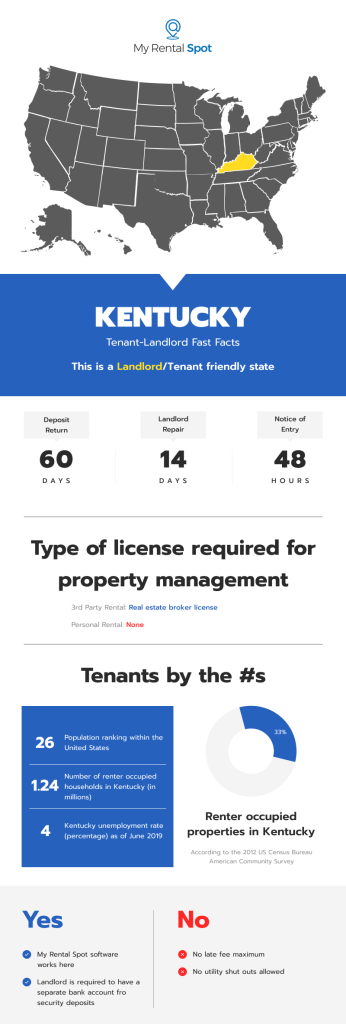
Deposit ReturnIf the tenant vacates the rental unit without paying the last month’s rent, the landlord may deduct the unpaid rent and return the remaining deposit after 30 days for unpaid rent ( Ky. Rev. Stat. Ann. § 383.580(6)). If the tenant does not owe rent, the landlord must send a notification to the tenant’s last known address. If the landlord does not receive an answer within 60 days, the tenant forfeits any right to the deposit.Full text below ↓
Entry NoticeTwo days and the landlord may only enter the premises at reasonable timesFull text below ↓
Landlords and tenants will face legal issues during the rental process, but not every issue needs to involve the courts. This article will help you learn how the laws in your state handle everything from security deposits to termination notices so you can navigate these with ease.
This article is notintended to be exhaustive or a substitute for qualified legal advice. Laws and statutes are subject to change and may vary by county or city. You are responsible for performing your research and complying with all laws applicable to your unique situation.
If you have legal questions or concerns, we recommend consulting with the appropriate government agencies and a qualified lawyer in your area. Your state bar association may have a referral service to help you find a lawyer with experience in landlord-tenant law.
Separate Security Deposit Bank Account: Required. Tenants shall be informed of the location of the separate account and the account number (Ky. Rev. Stat. Ann. § 383.580(1)). No landlord shall be entitled to retain any portion of a security deposit if the security deposit was not deposited in a separate account (Ky. Rev. Stat. Ann. § 383.580(4)).
Pet Deposits and Additional Fees: No statute.
Nonrefundable Deposits: No statute.
Deadline for Returning Security Deposit: If the tenant vacates the rental unit without paying the last month’s rent, the landlord may deduct the unpaid rent and return the remaining deposit after 30 days for unpaid rent ( Ky. Rev. Stat. Ann. § 383.580(6)). If the tenant does not owe rent, the landlord must send a notification to the tenant’s last known address. If the landlord does not receive an answer within 60 days, the tenant forfeits any right to the deposit. (Ky. Rev. Stat. Ann. § 383.580(7)).
Move-In Disclosure: A prospective tenant shall be presented with a comprehensive listing of any existing damage to the unit, which would be the basis for a charge against the security deposit. (Ky. Rev. Stat. Ann. § 383.580(2))
Advance Notice of Withholding: Required. The tenant also has the right to inspect the premises after receiving the itemized list of damages to verify the list’s accuracy (Ky. Rev. Stat. Ann. § 383.580(3)).
Record Keeping of Deposit Withholdings: No statute.
Receipt of Deposit: No statute.
Failure to Comply: No statute.
Lease, Rent, and Fees:
Rent Is Due: Rent is payable without demand or notice at the time and place agreed upon by the parties. Unless otherwise agreed, rent is due at the beginning of each month and is apportionable day-to-day. (Ky. Rev. Stat. Ann. § 383.565(2))
Default Term: Unless the rental agreement fixes a definite term, the tenancy is week-to-week in case of a tenant who pays weekly rent. In all other cases, the tenancy is considered month-to-month. (Ky. Rev. Stat. Ann. § 383.565(3))
Tenant Allowed to Repair and Deduct Rent: Yes, if the cost of the repair is less than $100 or 1/2 of the monthly rent, and the landlord is given 14 days notice but does not remedy the issue (Ky. Rev. Stat. Ann. § 383.635).
Termination for Lease Violation: 15 days to remedy or quit. Repeating offenders who commit the same violation within 6 months, after already receiving notice once before, can be given an unconditional quit notice (Ky. Rev. Stat. Ann. § 383.660(1)).
Termination under Labor Contract: “When a tenant enters or holds premises by a contract in which it is stipulated that he is to labor for his landlord, and he fails to begin to labor, or if, having begun, without good cause fails to comply with his contract, his right to the premises shall at once cease, and he shall abandon them without demand or notice” (Ky. Rev. Stat. Ann. § 383.130).
Required Notice before Entry: Two days and the landlord may only enter the premises at reasonable times (Ky. Rev. Stat. Ann. § 383.615).
Notice of Date/Time of Move-Out Inspection: No statute.
Notice of Extended Absence: If specified in the rental agreement, the tenant must give notice to the landlord of any absence of 7 days or longer. If the tenant fails to do so, the tenant can be held responsible for any damages resulting from his/her absence (Ky. Rev. Stat. Ann. § 383.670 and §383.620).
Consequences for Self-Help Eviction: Three months of periodic rent, reasonable attorney’s fees, and the return of any prepaid rent. (Ky. Rev. Stat. Ann. § 383.655)
Disclosures and Miscellaneous Notes:
Name and Addresses: Before a lease begins, the owner must disclose the name and address of the landlord, property owner, and anyone authorized to manage the property or allowed to receive notice on the owner’s behalf. (Ky. Rev. Stat. Ann. § 383.585(1))
House Rules and Regulations: A landlord has the right to create rules and regulations at any time, under certain circumstances. See the statute for more information. (Ky. Rev. Stat. Ann. § 383.610)
Compliance: Comply with the requirements of applicable building and housing codes materially affecting health and safety;
Repairs: Make all repairs and do whatever is necessary to put and keep the premises in a fit and habitable condition;
Common Areas: Keep all common areas of the premises in a clean and safe condition;
Maintenance: Maintain in good and safe working order and condition all electrical, plumbing, sanitary, heating, ventilating, air-conditioning, and other facilities and appliances, including elevators, supplied or required to be supplied by him; and
Heat: Supply running water and reasonable amounts of hot water at all times and reasonable heat between October 1 and May 1 except where the building that includes the dwelling unit is not required by law to be equipped for that purpose, or the dwelling unit is so constructed that heat or hot water is generated by an installation within the exclusive control of the tenant and supplied by a direct public utility connection.
Compliance: Comply with all obligations primarily imposed upon tenants by applicable provisions of building and housing codes materially affecting health and safety;
Cleanliness: Keep that part of the premises that he occupies and uses as clean and safe as the condition of the premises permits;
Trash: Dispose from his dwelling unit all ashes, garbage, rubbish, and other waste cleanly and safely;
Plumbing: Keep all plumbing fixtures in the dwelling unit or used by the tenant as clean as their condition permits;
Appliances: Use reasonably all electrical, plumbing, sanitary, heating, ventilating, air-conditioning, and other facilities and appliances including elevators in the premises;
Lawful Activity: Not deliberately or negligently destroy, deface, damage, impair or remove any part of the premises or knowingly permit any person to do so; and
Quiet Enjoyment: Conduct himself and require other persons on the premises with his consent to conduct themselves in a manner that will not disturb his neighbors’ peaceful enjoyment of the premises.
Retaliation: For one year thereafter, a landlord must not terminate, refuse to renew a lease, or fine a tenant for complaining to the landlord for a violation listed under Ky. Rev. Stat. Ann. § 383.595, for complaining to a government agency, or being involved in a tenant’s organization. (Ky. Rev. Stat. Ann. § 383.705)
Lead Disclosure: Landlords must disclose all known lead paint hazards. Landlords must also provide tenants, as an attachment to a written lease, with an information pamphlet on lead-based paint hazards.
Business License: No statewide statute, but local cities and counties may have regulations and requirements. Check with your local governing authority.
This guide is not legal advice. Laws change and may vary by county or city — verify
against the linked official statutes and consult a qualified lawyer for your situation.