
Landlords and tenants will face legal issues during the rental process, but not every issue needs to involve the courts. This article will help you learn how the laws in your state handle everything from security deposits to termination notices so you can navigate these with ease.
This article is not intended to be exhaustive or a substitute for qualified legal advice. Laws and statutes are subject to change and may vary by county or city. You are responsible for performing your research and complying with all laws applicable to your unique situation.
If you have legal questions or concerns, we recommend consulting with the appropriate government agencies and a qualified lawyer in your area. Your state bar association may have a referral service to help you find a lawyer with experience in landlord-tenant law.
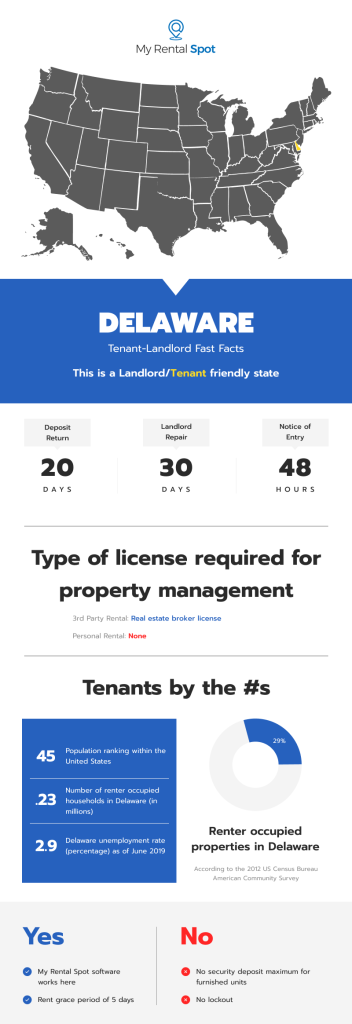
● Delaware Code Title 25 §§ Ch. 55 – Ch. 59 – Landlord and Tenant
● Attorney General’s Summary of the Delaware Residential Landlord-Tenant Code (pdf)
● Security Deposit Maximum: One month’s rent for tenancies that are one year or longer. There is no limit for furnished units. (Del. Code § 5514 (a))
● Security Deposit Interest: No statute
● Separate Security Deposit Bank Account: Required, and the account must be with a bank that is federally insured. The landlord must disclose the location of the account. (Del. Code § 5514 (b))
● Non-Refundable Fees: No statute.
● Pet Deposits: A landlord may require a pet deposit, which cannot exceed one month’s rent. (Del. Code § 5514 (i))
● Application Fee: Application fees can be no more than 10% of the monthly rent, or $50. The application fee can be used by the landlord to check the tenant’s credit and background (landlords cannot charge separate credit check fees). (Del. Code § 5514 (d))
● Deadline for Returning Security Deposit: 20 days (Del. Code § 5514 (f))
● Permitted Uses of the Deposit: The security deposit may be used to pay to repair damages made by the tenant beyond normal wear and tear; to pay unpaid rent, late fees, and termination fees; any “reasonable expenses” accrued to the early termination of the rental agreement (Del. Code § 5514 (c)).
● Security Deposit Can Be Withheld: Yes (Del. Code § 5514 (c)).
● Require Written Description/Itemized List of Damages and Charges: Yes (Del. Code § 5514 (f))
● Receipt of Deposit: No statute
● Record Keeping of Deposit Withholdings: No statute
● Failure to Comply: Failure to disclose the location of the deposit, or failure to return the deposit, minus deductions, within 20 days can entitle the tenant to double the amount of the deposit, or the amount wrongfully withheld. (Del. Code § 5514 (g))
● Written Agreement: Unless specific in writing, rental agreements are not effective for terms longer than one year. (Del. Code § 5106 (a))
● Month-to-Month Assumed: Unless specified otherwise, rental agreements are considered to be for month-to-month terms. (Del. Code § 5106 (b))
● Rent Is Due: Rent is due at the time and place agreed to by the parties. Unless otherwise agreed, the entire rent shall be payable at the beginning of any term of one month or less, while one month’s rent shall be payable at the beginning of each month of a longer term. (Del. Code § 5501 (b))
● Payment Methods: If a landlord accepts a cash payment for rent, the landlord shall, within 15 days, give the tenant a receipt for that payment. The landlord shall, for a period of 3 years, maintain a record of all cash receipts for rent. (Del. Code § 5501 (e))
● Rent Increase Notice: 60 days. The tenant then has 15 days to notify the landlord if they plan to terminate the lease before the rent increase takes effect. Otherwise, the new terms are considered accepted. (Del. Code § 5107 (a)(b))
● Rent Grace Period: Five Days, unless the landlord doesn’t have an office in the county where the rental property is located, in which case the grace period is eight days. (Del. Code § 5501(d))
● Late Fees: Not to exceed 5% of the rent. Late fees are considered as additional rent. (Del. Code § 5501 (d))
● Prepaid Rent: No statute
● Returned Check Fees: $40, plus court costs (Del. Code § 1301A)
● Tenant Allowed to Withhold Rent for Failure to Provide Essential Services (Water, Heat, etc.): Yes, the tenant may withhold up to two-thirds of the rent per day, accruing during any period when hot water, heat, water, or equivalent substitute housing is not supplied. The tenant must provide the landlord, via writing, notice that rent is being withheld. (Del. Code § 5308 (b)(3)).
● Tenant Allowed to Repair and Deduct Rent: Yes, but conditions apply. Read Del. Code §5307 for instructions.
● Landlord Allowed to Recover Court and Attorney’s Fees: No statute
● Landlord Must Make a Reasonable Attempt to Mitigate Damages to Lessee, including an Attempt to Re-rent: Yes, but until the property is re-rented, the tenant would be responsible for all rent and expenses (Del. Code § 5507 (d)).
● Abandonment/Early Termination Fee: No statute, but similar guidance is found in Del. Code § 5507.
● Notice to Terminate Tenancy – Fixed End Date in Lease: 60 days notice prior to the expiration date (Del. Code § 5106 (c))
● Notice to Terminate Any Periodic Lease of a Year or More: There is no statute related to this specific time period. However, the statute allows landlords to “terminate any rental agreement,” with the exception of month-to-month agreements, with 60 days’ notice.(Del. Code § 5106 (c))
● Notice to Terminate a Periodic Lease – Month-to-Month: 60 days (Del. Code § 5106 (d))
● Notice to Terminate a Periodic Lease – Week-to-week: No statute
● Unconditional and Immediate Lease Termination: The landlord may terminate the lease immediately when a tenant causes or threatens to cause irreparable harm to a person or the property. (Del. Code § 5513 (b))
● Notice of date/time of Move-Out Inspection: No statute
● Eviction Notice for Nonpayment of Rent: 5 days (Del. Code § 5502 (a))
● Eviction Notice for Lease Violation: 7 days (Del. Code § 5513 (a))
● Required Notice before Entry: 48 Hours (Del. Code § 5509 (b))
● Entry Allowed with Notice for Maintenance and Repairs (non-emergency): Yes, 48 hours’ notice must be given (Del. Code § 5509 (b)).
● Emergency Entry Allowed without Notice: Allowed (Del. Code § 5509 (b))
● Entry Allowed During Tenant’s Extended Absence: Allowed (Del. Code § 5507 (b))
● Entry Allowed to Show Unit to Prospective Tenants: 48 hours, but a tenant may waive this requirement, in writing, to make it easier for prospective tenants or purchasers to view the property. (Del. Code § 5509 (b))
● Notice to Tenants for Pesticide Use: No statute
● Lockouts Allowed: No (Del. Code § 5313)
● Utility Shut-offs Allowed: No (Del. Code § 5313)
● Penalty for Self-Help Eviction: If the landlord attempts to exclude the tenant from the rental unit, the tenant can “recover treble the damages sustained or an amount equal to 3 times the per diem rent for the period the tenant was excluded from the unit, whichever is greater, and the costs of the suit excluding attorney’s fees.” (Del. Code § 5313)
● Names and Addresses: Landlords must disclose the names and addresses of the rental unit’s owners, as well as the landlord’s name and address (Del. Code § 5105).
● Summary of Landlord-Tenant Laws: A summary of the Landlord-Tenant Code, as prepared by the Consumer Protection Unit of the Attorney General’s Office or its successor agency, shall be given to the new tenant at the beginning of the rental term. If the landlord fails to provide the summary, the tenant may plead ignorance of the law as a defense (Del. Code § 5118). Download the Summary.
● Copy of the Lease: Landlords must provide tenants with a written copy of the agreement, free of charge (Del. Code § 5105 (b))
● Domestic Violence Situations:
● Handling Abandoned Personal Property:
● Landlord’s Duties: (Del. Code § 5305 (a))
● Tenant’s Duties: (Del. Code § 5503)
● Retaliation: Landlord must not terminate or refuse to renew a lease, increase rent, or decrease services to a tenant who has filed an official complaint to a Government Authority, has been involved in a tenant’s organization, or has exercised some legal right. Other actions are prohibited and retaliation is assumed by the courts if the landlord acts negatively within 90 days. (Del. Code § 5516)
● Lead Disclosure: Landlords must disclose all known lead paint hazards. Landlords must also provide tenants, as an attachment to a written lease, with an information pamphlet on lead-based paint hazards.
● Small Claims Court Limits: $15,000 (Del. Code § 9301(1))
● Eviction Cases Allowed: Yes (Del. Code § 9301(3)) ● Delaware Small Claims Court
●Statute of Limitations
● Delaware Court System
● Delaware Attorney General
● Delaware State Bar Association
● Legal Aid:
● Business License required: No statewide statute, but local cities and counties may have regulations and requirements. Check with your local governing authority.
● U.S. Department of Housing and Urban Development – Delaware
● Delaware Department of Insurance
● Delaware Consumer Guide to Homeowner Insurance (pdf)
● Delaware Fraud and Consumer Protection Division
● Delaware Housing Commission
● Delaware Real Estate Commission
● Delaware State Housing Authority
● Wilmington Housing Authority
REALTORS® Associations
○ Delaware Association of REALTORS®
○ New Castle County Regional Association of REALTORS®
○ Kent County Association of REALTORS®
○ Sussex County Association of REALTORS®
Landlord Associations
○ Delaware Apartment Association
○ Delaware Real Estate Investors Association
○ Newark Landlord Association
Managing a rental in Delaware? Collect rent free with My Rental Spot →
This guide is not legal advice. Laws change and may vary by county or city — verify against the linked official statutes and consult a qualified lawyer for your situation.